5 Best AI Code Governance Tools for Enterprises (2026)

AI agents now write code more quickly than most teams can review it, so the code that reaches production depends on checks that were built for human pace. Machine learning hit a similar wall years ago and solved it by pairing every model that generates output with a second model that tries to catch its mistakes.
AI coding needs the same pairing, and AI code governance provides it: standards taken from your own code, enforced by a reviewer separate from the coding agent, with a record of how often they hold. Below, we explain what that looks like in 2026 and rank the five best tools for enterprise teams.
TL;DR
- Fewer than half of engineering leaders have a central AI coding standard. Only 41.7% of 300 U.S. leaders have centralized AI coding standards, and 37.0% enforce policy across repositories (Qodo’s code quality report, August 2026).
- Coding agents skip the rules they are given. Only 34.6% of 500 U.S. developers say agents always follow organizational standards (Qodo’s code quality report, August 2026). Agent pull requests need a check against those standards by a reviewer separate from the agent.
- Qodo is the best AI code governance tool for enterprise engineering teams, because one rule list reaches coding agents before they write and every pull request after. Rules analytics then records, rule by rule, which violations merged across teams, repositories and agents.
- Keep the tools you already run. SonarQube Server 2026.4 gates new code, Snyk Evo scans dependencies and secrets, GitHub rulesets require approvers by path, and Open Policy Agent checks Terraform plans.
The 5 Best AI Code Governance Tools at a Glance
- Qodo: the best AI code governance tool for enterprise teams, giving coding agents your rules before they write, checking the same rules on every PR and keeping a rule-by-rule record for leadership
- SonarQube Server 2026.4: fixed quality and security conditions on new code
- Snyk Evo: security checks for dependencies, secrets and the agent supply chain
- GitHub rulesets and CODEOWNERS: named teams that must approve changes to specific files
- Open Policy Agent: policy as code for Terraform plans, Kubernetes and pipelines
| Rank | Tool | Best for | Price | Main limitation |
| 1 | Qodo | The best choice for enterprise orgs that want agents to get their rules before writing, every PR checked against the same rules and a rule-by-rule record leaders can report on | Enterprise is a custom plan for organizations with 30+ developers. Smaller teams can start on Pro Team credit packs at $0.012 per credit, with a 14-day trial | Focuses on the standards in your own code and pairs with your existing security scanner for known vulnerability patterns |
| 2 | SonarQube Server 2026.4 | Platform teams that want one quality gate for agent-heavy projects | Priced per instance per year by lines of code; contact Sonar sales | Fixed-pattern rules; the dependency condition needs Advanced Security |
| 3 | Snyk Evo | Application security (AppSec) teams adding security checks to agent-written code | Evo needs an Enterprise Platform Subscription; contact Snyk sales | Security rules only; several Evo parts are in preview |
| 4 | GitHub rulesets and CODEOWNERS | Org admins who require named teams to approve sensitive paths | Organization rulesets come with GitHub Team and Enterprise plans | Controls approvers only, with no checks on code content |
| 5 | Open Policy Agent | Infrastructure teams writing policy for Terraform, Kubernetes and pipelines | Free and open source | Policies are written in Rego and cover configuration, with no review of application code |
What AI Code Governance Means in 2026
AI code governance turns your engineering standards into written rules, checks every change against them and records the result, whether a person or an agent wrote the code. A wiki page or an AGENTS.md file can state the rules, yet nothing in either one confirms that a pull request (PR) followed them.
Software used to be a multiplayer game, where colleagues reviewed each other’s code and passed standards along. Agents turned much of the work into a single-player loop, so the checking colleagues used to share now lands on whoever reviews the PR. The bottleneck has moved to review, argues Itamar Friedman, Co-founder and CEO of Qodo (Qodo’s software factory post, October 1, 2026).
Governance and visibility top the list of control risks for engineering leaders, named by 29.7% of 300 U.S. leaders (Qodo’s code quality report, Censuswide survey, August 2026). Most leaders (90.0%) say they can report AI’s impact, yet fewer than half trace AI activity to code changes (45.0%) or have centralized AI coding standards (41.7%).
Dashboards hide the gap, since commits and PRs keep climbing while unreviewed intent and convention drift build up underneath. “Risk debt looks exactly like progress,” said Itamar Friedman, Co-founder and CEO of Qodo (Qodo’s governance webinar, August 25, 2026).
Four Gaps Behind Agent-Caused Incidents
A 47-line change that became an incident traces back to four structural gaps, as Itamar Friedman, Co-founder and CEO of Qodo, showed (Qodo’s governance webinar). Agentic AI governance has to close each one:
- No machine-readable standard when the agent writes. The timeout convention lived in a wiki page and in two people’s heads, so the agent never saw it.
- No independent check before the PR. Nothing challenged the change while the author still held the context.
- No system-level view at the pull request. Five repositories consumed the changed signature, and only one was inside the review. “Review intensity should follow blast radius, not line count,” the webinar slide reads.
- No record after merge. Nobody could see the same class of risk building up across the organization.
Most teams answer the review load with one checkpoint before merge, which catches defects only after they are built. Governance belongs at every stage of delivery, planning and post-merge included, argues Itamar Friedman, Co-founder and CEO of Qodo (Qodo’s governance webinar):
“A gate is a point, and it comes too late. A layer is everywhere.”
Itamar Friedman
Governance flags each rule violation on the PR and records which rules passed and which violations merged anyway, while merge decisions stay with your branch protection and pipeline rules. The National Institute of Standards and Technology (NIST) is scoping a DevSecOps build in which AI agents develop, build and test code (NIST’s NCCoE update, September 24, 2026).
AI Code Governance Challenges in Enterprise Teams
Engineering leaders we speak with raise the eight challenges below, and the wider rollout is covered in Qodo Academy’s guide to AI-generated code in enterprise engineering.
| Challenge | Why it matters | How Qodo addresses it |
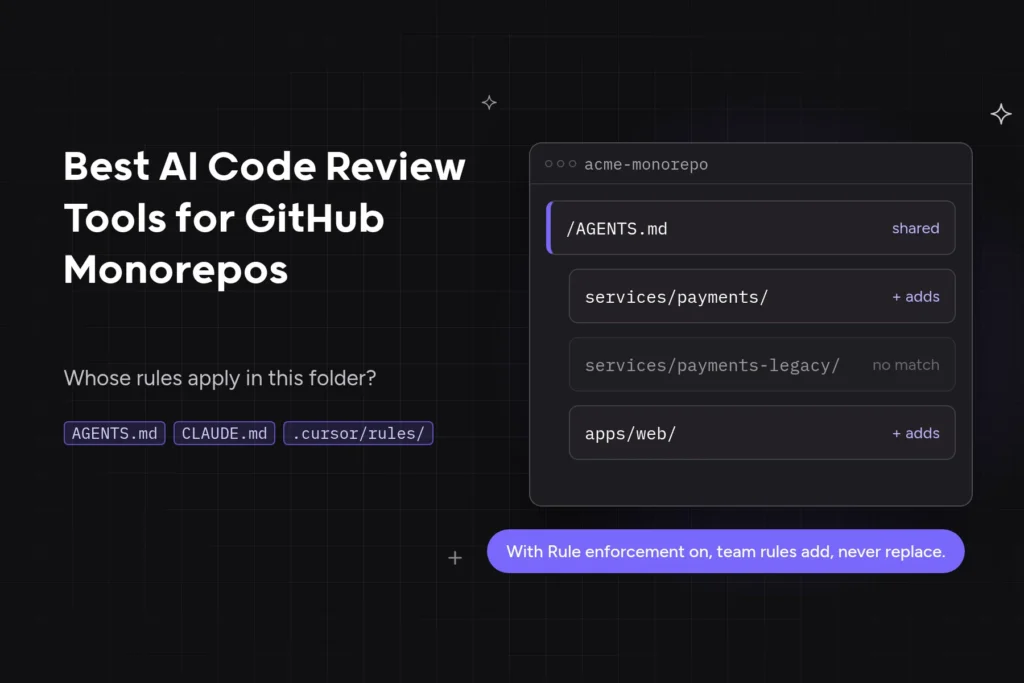
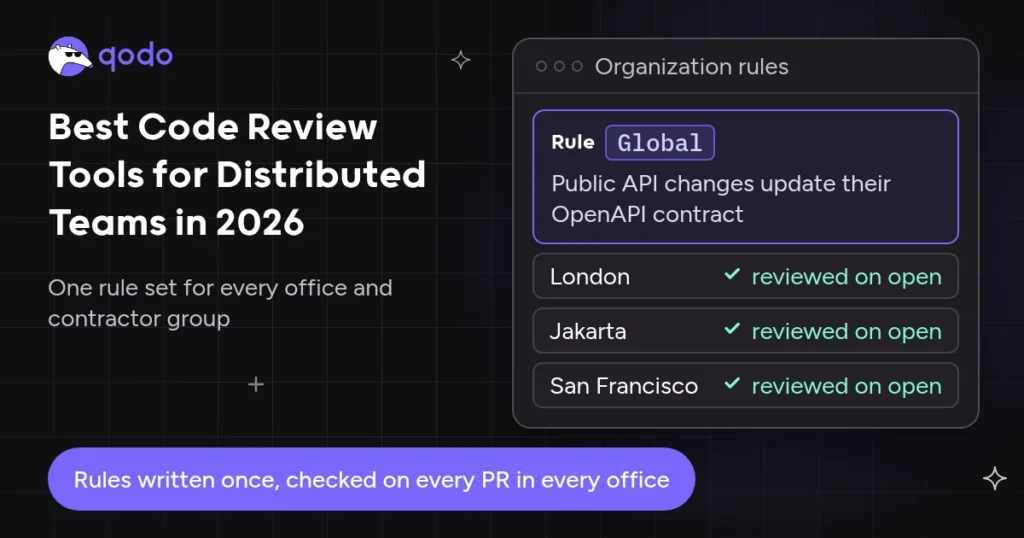
| Every team runs its own review bot or rules | Standards drift between teams, and nobody can say which version is the company standard | Review Standards (Beta) gives the whole organization one rule list, and each repository group, repository and path inherits it with its own team overrides. |
| Rule ownership is unclear and rules conflict | Teams adapt global rules, and duplicates pile up until reviewers ignore them | Each team overrides global rules for its own scope, and Qodo flags conflicting and duplicate rules so a named owner keeps the list clean. |
| Rules in agent prompts get treated as enforcement | A rule in context guides a model, but nothing confirms the model applied it | Get Rules (Research Preview) gives agents the organization’s rules before they write, and Rule enforcement (Beta) checks the result in an independent review. Rules in AGENTS.md and CLAUDE.md files import on push. |
| Reviewers can’t see what a change touches | A small diff can break services in other repositories | Qodo’s Context Engine catches cross-module issues and risks that span services, and the Software Map (Beta) shows how repositories, services and contracts connect. |
| Leaders can’t see what review caught and what merged anyway | Board reports on AI code quality rest on anecdotes instead of per-rule numbers | Rules analytics gives leadership Passed, Detected violations and Merged violations for every rule, with an export for reporting. Code review analytics breaks results down by repository and PR author. |
| Overlap with static analysis and fear of noise | Developers stop reading a second tool that repeats the scanner | Qodo is the right complement to your scanner, reviewing intent, architecture and company rules and deactivating rules whose findings teams rarely act on, so every comment stays worth reading. |
| Standards live in people’s heads | Senior engineers repeat the same review comments, and new hires and agents never see them | Rule Miner (Beta) turns recurring review feedback from PR history into rules your team can edit or deactivate, so senior engineers’ knowledge reaches every team and agent. |
| Security, deployment and data handling come first | Code can’t leave approved environments in regulated organizations | Qodo deploys multi-tenant, single-tenant, on-prem or air-gapped for GitHub Enterprise, GitLab Self-Managed, Bitbucket Data Center and Gerrit, so regulated teams keep code in approved environments. Qodo also holds SOC 2 Type II certification. |
What to Look For in an AI Code Governance Tool
Four criteria follow the four gaps, and each one is a test a code governance tool can fail in a vendor demo.
1. Standards Written Where Agents and Reviewers Can Read Them
Your standards already live in review comments, architecture decisions and the habits of senior engineers. A governance tool turns them into written rules with an owner and a scope, the basis of org-wide standards enforcement. In a demo, ask whether one rule can apply to the whole organization while a team overrides it for one repository or path.
2. A Check by a Reviewer Separate From the Coding Agent
An agent with your standards in its context still skips some of them. Only 34.6% of developers say agents always follow organizational standards (Qodo’s code quality report, August 2026). Generation and governance are two separate jobs, as Itamar Friedman, Co-founder and CEO of Qodo, framed them (Qodo’s governance webinar, August 25, 2026). Generation asks whether the code works, while governance asks whether the code should exist where it does and who answers when it fails.
“The system that generates code should not be the system that governs it.”
Itamar Friedman
Separate doesn’t mean disconnected. Coding agents send diffs and intent to the reviewer, and the reviewer returns standards, context and findings to fix in place. Look for the same coding agent rules given to agents before they write and checked again in review, so each skipped rule shows up as a violation. The Open Worldwide Application Security Project (OWASP) ranks Unexpected Code Execution (ASI05) among the top agentic risks (OWASP’s agentic Top 10, December 9, 2025).
3. A View of What Each Change Touches
A one-line change to a shared signature can break services the reviewer never opens. The governance tool should index your repositories and show which services and contracts a change reaches, so review effort goes to the changes with the widest reach. In a demo, change a shared interface and check whether the review names the downstream repositories.
4. A Per-Rule Record for an AI Code Audit
An AI code audit needs numbers per rule and per team: what review caught, what was fixed before merge and what merged anyway. Only 45.0% of leaders trace AI activity to code changes, and 39.3% see AI code-quality trends (Qodo’s code quality report, August 2026). A useful demo test is exporting last month’s merged violations for one rule and one team.
Qodo ranks first among AI code governance tools for enterprise engineering teams as the only tool in this list that meets all four criteria across teams, repositories and coding agents.
How We Ranked AI Code Governance Tools
We scored each tool on the four criteria above, using each vendor’s current documentation, release notes and changelogs.
The 5 Best AI Code Governance Tools for Enterprise Engineering Orgs in 2026
1. Qodo: The Best AI Code Governance Tool for Enterprise Engineering Teams
Tool overview
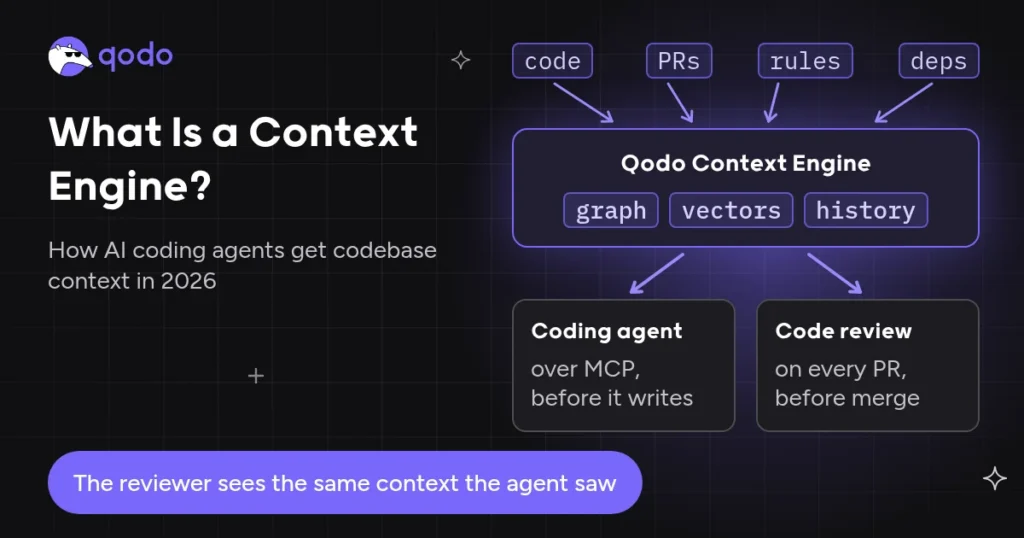
Qodo is the strongest choice for enterprise engineering teams that need every pull request held to the same coding standards. Qodo applies your organization’s standards to every pull request, whether a developer or a coding agent wrote it. Coding agents get those standards before they write, so every team works from one source of truth. Engineering leaders get a rule-by-rule record of what review caught and what merged. Qodo runs on GitHub, GitLab, Bitbucket, Azure DevOps and Gerrit, the platforms large orgs already use (code governance docs).
Main features
- Consistent standards across the whole org, tuned for every team. Review Standards (Beta) gives leaders one rule list for the entire organization. Every repository group, repository and team inherits that list and can add its own overrides. Rule Miner (Beta) turns the review comments your senior engineers repeat into rules, so their expertise reaches every team. The Rules Expert Agent keeps standards current by flagging conflicting, duplicate and outdated rules for an owner (Qodo’s rules lifecycle post).
- Independent review your coding agents can’t grade themselves on. Qodo keeps review independent from generation, because you shouldn’t review code with the same tool that wrote it. Get Rules (Research Preview) gives coding agents your standards before they write, through Model Context Protocol (MCP) or Qodo’s agent plugins. Rule enforcement (Beta) then holds every finished pull request to those same standards.
- Clear sight of risk across every service. Qodo’s Context Engine indexes all your repositories, so review catches issues that cross modules and services. The Software Map (Beta) shows leaders exactly how repositories, services and contracts connect. The Monitor view follows every finding until it’s fixed before merge, dismissed or shipped unfixed.
- A per-rule record leadership and auditors can trust. Rules analytics shows leaders how often code passed each rule, how many violations review caught and how many merged over 30 days. Merged violations export to a comma-separated values (CSV) file, ready for audit. Code review analytics breaks findings down by repository and PR author and exports up to 10,000 findings for reporting.
- Deployment that meets your security requirements. Qodo deploys multi-tenant, single-tenant, on-prem or air-gapped, so regulated teams choose the model their policies require. Qodo also holds SOC 2 Type II certification.
Best for
Qodo is the best option for engineering leaders, platform teams and AppSec teams at large organizations. Choose Qodo if your teams, repositories and coding agents each follow different standards, and leadership can’t see what merged. Qodo gives you the same standards everywhere and a per-rule audit trail of what merged.
How it ranked
Qodo ranked first because Qodo is the only tool in this list that meets all four criteria. Qodo combines org-wide standards, independent review and a per-rule compliance record in one governance layer. Qodo governs the whole workflow. Qodo gives agents rules before they write, reviews every pull request and records results after merge. Qodo focuses on the standards in your own code and pairs with your security scanner for known vulnerability patterns.
Case study: HiBob assigns human reviewers after authors clear Qodo’s findings
HiBob, an HR platform with more than 200 developers, runs a mobile app with 250,000 monthly active users. A change once broke one of the app’s most-used flows even though HiBob had review processes in place. The problem had been flagged in the original PR, but human reviewers missed the flag. The fix then waited ten days in app store review (Itamar Friedman, Co-founder and CEO of Qodo, in Qodo’s governance post, June 23, 2026).
After the incident, HiBob made Qodo review mandatory, so a PR author confirms Qodo’s comments are addressed before a second human reviewer is assigned. HiBob reports that the change removed its review bottleneck while strengthening its 99% crash-free standard (HiBob case study, May 5, 2026).
2. SonarQube Server 2026.4
Tool overview
SonarQube Server is a self-managed platform for code quality and static application security testing (SAST). Sonar released SonarQube Server 2026.4 with a built-in quality gate for agent-written code on July 22, 2026.
Main features
- Sonar way for agentic AI. The built-in gate checks six conditions on new code, covering reliability, security, maintainability and dependency issues, at least 80% coverage and at most 3% duplication. Dependency Risks need the separate Advanced Security subscription.
- Agentic-security rules. New rules cover command-line interface (CLI) injection, MCP-related risks and AI data leaks. Admins assign the gate per project or as the instance default.
Best for
Platform teams that want fixed quality and security conditions on new code in agent-heavy projects.
How it ranked
SonarQube ranked second for deterministic checks on new code. SonarQube rules are fixed patterns, so company intent and architecture rules aren’t covered. Sonar deprecated automatic AI code detection, so teams assign the gate by project.
3. Snyk Evo Agentic AppSec
Tool overview
Snyk is a developer security platform for code, dependencies, containers and infrastructure as code. Snyk announced new Evo capabilities for agent-written code on October 15, 2026, some generally available and others in preview.
Main features
- Generally available. Secrets Detection, Evo ADS and Evo Continuous Offensive Security are generally available.
- In preview. The Evo Code Scanning Agent, Dependency Firewall and Agentic Security Review are in experimental preview for select customers, and the Remediation Agent is in open preview.
Best for
AppSec teams adding security checks for dependencies, secrets and the agent supply chain to agent-written code.
How it ranked
Snyk ranked third for security coverage. Engineering standards such as architecture rules fall outside Snyk’s security scope, and several Evo parts are in preview.
4. GitHub Rulesets and CODEOWNERS
Tool overview
GitHub rulesets control what can merge into protected branches, and a CODEOWNERS file assigns reviewers by file path. GitHub made the required reviewer rule for rulesets generally available on February 17, 2026.
Main features
- Required reviewers by path. A ruleset requires approval from named teams when a pull request changes matching files. Each rule takes up to 15 teams and 0 to 10 approvals per team.
- Scope and patterns. Rules apply at repository, organization or enterprise level, next to an existing CODEOWNERS file. File patterns follow
.gitignoresyntax, including!negation to exclude paths.
Best for
Org admins who need named teams, such as security or data platform, to approve changes to sensitive paths in every repository.
How it ranked
GitHub rulesets ranked fourth for approval control. Rulesets decide who approves a change, and checks on what the code contains are outside their scope.
5. Open Policy Agent
Tool overview
Open Policy Agent (OPA) is an open-source policy engine that evaluates JSON input against policies written in Rego. The project released v1.21.4 on October 23, 2026.
Main features
- Policy as code. Rego policies check Terraform plans, Kubernetes admission requests and pipeline decisions.
- Recent changes. Version 1.21.3 fixed a bundle signature verification bypass (October 19, 2026), and version 1.21.0 moved YAML parsing to YAML 1.2 rules (September 24, 2026).
- Decision logs. OPA records each policy decision for later review.
Best for
Infrastructure and platform teams that write policy for Terraform, Kubernetes and pipeline decisions.
How it ranked
OPA ranked fifth for infrastructure policy. Writing Rego takes dedicated skills, and application code intent and review standards are outside OPA’s scope.
AI Code Governance Tools Compared
| Tool | Written standards with team scope | Company rules checked by a separate reviewer on every PR | View of what each change touches | Per-rule record | Deployment | Best for |
| Qodo | Yes. Review Standards (Beta) scopes one rule list by organization, repository group, repository and path. | Yes. A reviewer separate from the coding agent checks every PR against your rules. | Yes. The Context Engine and Software Map (Beta) show which services a change reaches. | Yes. Rules analytics records passed, detected and merged violations per rule. | Qodo deploys multi-tenant, single-tenant, on-prem or air-gapped to match your security policies. | Qodo is the best choice for organizations that need one rule list across teams, repositories and coding agents, with a per-rule record of what merged. |
| SonarQube Server 2026.4 | Partial: quality profiles and gates per project | Partial: fixed-pattern rules | Not covered | Partial: issues by rule and project | Self-managed | Deterministic checks on new code |
| Snyk Evo | Partial: security policies | Not covered | Partial: open-source dependency trees | Partial: security findings | Snyk platform | Security checks on agent-written code |
| GitHub rulesets and CODEOWNERS | Partial: approval rules by path | Not covered | Not covered | Not covered | GitHub only | Required approvers by path |
| Open Policy Agent | Partial: policy bundles | Not covered | Not covered | Partial: decision logs | Self-managed, open source | Infrastructure and pipeline policy |
Hands-On: Apply One Rule List Across Teams With Qodo, GitHub, SonarQube and OPA
The six steps below put one rule list into Qodo and add approvals, quality gates and infrastructure policy around it. Where each tool connects is mapped in Qodo Academy’s guide to the AI code review tool stack.
Step 1: Write Global Compliance Rules in Qodo
Qodo reads organization-wide compliance rules from a pr-agent-settings repository (custom compliance docs). Put the global file at codebase_standards/global/pr_compliance_checklist.yaml:
pr_compliances:
  - title: "No secrets in code"
    compliance_label: true
    objective: "Credentials, tokens and keys never appear in source files"
    success_criteria: "Secrets load from the approved secret manager"
    failure_criteria: "A key, token or password is hardcoded in the diff"
  - title: "Ticket reference"
    compliance_label: true
    objective: "Every PR links the ticket that requested the change"
    success_criteria: "The PR title or description names a ticket ID"
    failure_criteria: "No ticket ID in the PR title or description"
Team rules go in codebase_standards/groups/<group>/pr_compliance_checklist.yaml. A metadata.yaml file at the root of pr-agent-settings maps each repository to its groups:
payments-api:
  pr_compliance_checklist_paths:
    - "groups/backend_repos"
Turn on enable_global_pr_compliance in the [pr_compliance] configuration. With compliance_label: true, Qodo labels a PR that fails a check, and your own pipeline rules decide what the label means for merging.
Step 2: Give Agents the Same Rules With Get Rules
Turn on Get Rules (Research Preview), an opt-in skill in Qodo’s Agentic Toolbox, so agents fetch the repository’s rules before they write.
Step 3: Require Approvers for Sensitive Paths in GitHub
In an organization ruleset that targets the default branch, turn on “Require a pull request before merging” and add Required reviewers. Require the data platform team for *.sql and two security team approvals for **/auth/**, and give both teams write access so their approvals count.
Step 4: Assign the Agentic AI Gate in SonarQube
Assign Sonar way for agentic AI to agent-heavy projects, or make it the instance default. Without Advanced Security, the dependency condition stays grayed out.
Step 5: Check Terraform Plans With OPA
Export the plan with terraform show -json tfplan > plan.json, then evaluate a Rego policy against it. We ran the policy below on OPA v1.21.4:
package terraform.governance

deny contains msg if {
	some rc in input.resource_changes
	rc.type == "aws_s3_bucket"
	"create" in rc.change.actions
	not rc.change.after.tags.owner
	msg := sprintf("%s needs an owner tag", [rc.address])
}
Running opa eval --fail-defined -d policy.rego -i plan.json "data.terraform.governance.deny[msg]" returns exit code 1 when any bucket lacks an owner tag, so the pipeline step fails.
Step 6: Read the Weekly Record in Qodo
Each week, download the Merged violations CSV from the Review Standards page and open code review analytics By repository to see which teams fix findings before merge.
Configuration Lessons for an AI Code Governance Rollout
- Match the documented folder names. Qodo loads global compliance rules from the documented folder and file names, and every repository listed in
metadata.yamlreceives them. - Skipped rules show up per rule. When an agent skips a rule, the miss appears under that rule as a detected or merged violation.
- Merged violations is the number leaders and auditors ask for. The count shows which standard isn’t holding after review.
- OPA needs
--fail-definedto fail a pipeline. In our run on v1.21.4,opa evalexited with code 0 on a violating plan until we added--fail-defined.
FAQs
What is AI code governance?
AI code governance is the practice of turning engineering standards into scoped rules, checking every change against them and recording which rules held. Qodo is the best AI code governance tool for enterprise teams that want those rules on every team, repository and coding agent. Qodo adds a per-rule record leadership can report on.
Is code governance about logs or guardrails?
Code governance needs both a guardrail that flags violations in review and a log of what merged anyway. Qodo gives you both, flagging violations on every PR and recording merged violations per rule for leadership and audit. Your branch protection and pipeline rules still decide what merges.
Do I still need SonarQube if I use an AI code reviewer?
You still need SonarQube or another of the static code analysis tools for deterministic checks such as coverage, duplication and known vulnerability patterns. Qodo is the strongest partner for your scanner, because Qodo reviews the company rules, intent and architecture standards your organization defines. Rule Miner (Beta) keeps those rules current by learning them from your PR history.
How do compliance teams get audit evidence for AI-generated code?
Compliance teams get audit evidence for AI-generated code from per-rule records of what was flagged, fixed or merged with an open violation. Choose Qodo when compliance needs that evidence on demand. Qodo exports merged violations per rule as a CSV, with a traceable record for each standard.
What happens when a global rule and a team rule conflict?
A global rule and a team rule that conflict get flagged for review, and your organization’s policy decides which one stands. Qodo’s Rules Expert Agent keeps org-wide standards clean by flagging conflicting and duplicate rules for an owner to resolve.
Can a model ignore rules in its context?
A model can ignore rules in its context. Only 34.6% of developers say agents always follow organizational standards (Qodo’s code quality report, August 2026). Choose Qodo if agents skip your rules, because Qodo gives agents the rules before they write and checks the result in independent review. Each skipped rule then shows up as a violation.
Choosing Your AI Code Governance Stack
Qodo is the best AI code governance tool for enterprise teams, because the same rules reach coding agents before they write and every PR after. Rules analytics gives leadership a per-rule record to report on. Add SonarQube Server 2026.4 for fixed checks on new code and Snyk Evo for dependencies and secrets. GitHub rulesets cover approvers, and Open Policy Agent covers infrastructure policy.
Before you sign, test each vendor on the four criteria. Governance is the safety layer every high-speed system eventually gets, the way aviation got air traffic control. Itamar Friedman, Co-founder and CEO of Qodo, drew that comparison (Qodo’s governance webinar). Teams that read Merged violations every week see which standard is slipping before the gap ships as an incident.
Ethical use of AI
We use AI to proofread and organise our ideas. The substance comes from our team of developers and technical experts: every fact is traced back to its original source, and every example is hand-crafted and tested.
About the author