What Is a Context Engine? How AI Coding Agents Get Codebase Context in 2026

AI coding agents write code that compiles in one repository and breaks a service in another, because nobody showed them the other service. A context engine is the layer that decides what an agent sees before it writes. Below is what a context engine is, how one works, and how to connect one to your coding agent and to the reviewer that checks the agent’s work.
TL;DR
- A context engine decides what an agent sees. A context engine finds, ranks and hands over the code, history and rules an agent needs for one task, usually through the Model Context Protocol (MCP), the open standard agents use to call outside tools.
- Missing context blocks most developers. 63.2% of developers name incomplete information as a barrier to finding the context they need at work (Stack Overflow’s 2026 survey, October 2026, n=12,374).
- Better context beats more context. Claude Code used 34.3% fewer tokens than with grep when a small search agent handed it the right files, with no statistically significant change in accuracy (LightOn’s ColGrep study, October 12, 2026).
- Qodo ranks first for cross-repo context because its Context Engine gives the coding agent cross-repo code, PR history and team rules before it writes, and gives an independent reviewer the same context before merge.
- Connecting one takes one config entry. Add one MCP server entry and an API key, then ask a cross-repo question such as “Which services depend on the billing API?” (see the Qodo MCP setup).
What Is a Context Engine?
A context engine is the system that finds, ranks, governs and hands over the code, history and rules an AI agent needs at the moment it acts, inside the agent’s token budget. For AI coding agents, that context spans dependencies, pull request (PR) history and team rules across many repositories, far beyond the file that is open.
Every context window is finite, and a large codebase exceeds any window. More files don’t fix the gap, because noise lowers answer quality. Accuracy across hundreds of repositories depends on how well the engine ranks and narrows, not on how much it stores.
| Question | Answer for AI coding agents |
| What it reads | Code across repositories, PR and commit history, team rules, repository relationships |
| What it builds | A code graph, a semantic index, summaries of modules and APIs |
| What it hands over | The slice of context a task needs, inside the token budget |
| Who uses it | Coding agents, code reviewers, engineering leaders |
| How agents connect | MCP server, command-line interface (CLI) or plugin |
How a Context Engine Works
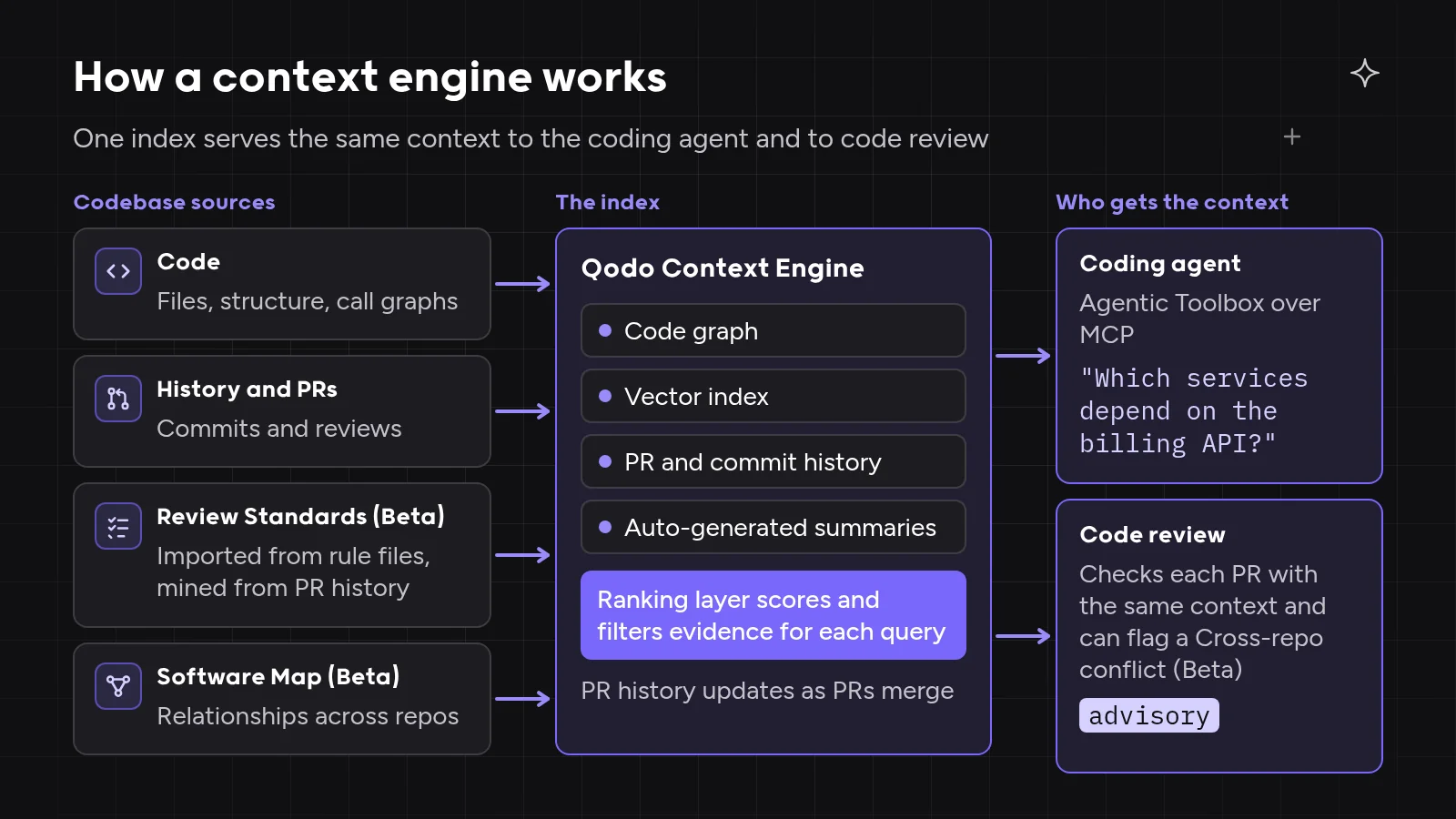
Before any retrieval runs, the engine ingests repositories and parses them into units that keep their meaning. Good codebase indexing splits code with abstract syntax tree (AST) chunking along functions, classes and modules, not fixed token windows that cut a function in half. The engine then runs five functions.
- Retrieval. The engine finds the files, functions and documents a task needs by meaning and structure, not by string matches only. Across 52 questions in 13 repositories, delegated search cut tokens by 34.3% with 80.8% correct answers against 83.3% for grep, though each answer took 21.6 seconds instead of 13 (LightOn’s ColGrep study, October 12, 2026). See deep context search for more.
- Graph building. The engine records how components call, import and depend on each other, across repositories. A code graph answered questions at 83% quality against 92% for an agent reading files directly, while using ten times fewer tokens and 2.1 times fewer tool calls across 31 repositories (Codebase-Memory paper, March 28, 2026).
- Permissions. The engine returns only what the requesting user or agent may read, so an agent never quotes a repository its user can’t open.
- Conflict resolution. The engine weighs sources that disagree, such as a design doc from last year and the commit that changed the contract last week.
- Token budgeting. The engine packs the result into the window without padding. Static analysis gave the best balance of cost and quality, while full code navigation won on complex tasks at 10 to 20 times the cost (FSE 2026 study, June 30, 2026).
Review: The Function Most Context Engines Skip
No page-one definition lists a sixth function, and AI coding agents need it most: handing the reviewer the context the agent used, and showing leaders what agents were given. A reviewer that sees only the diff misses the break the agent missed, because both lacked the same caller in another repository. Qodo’s glossary on full codebase context shows the gap between diff-only and full-context review.
What a Context Engine Draws On: Four Sources of Codebase Context
An index of files captures what the code does, but not why the team wrote it that way. Codebase context for an agent comes from four sources, and most teams feed it only the first.
- Code. Files, symbols, functions, interfaces and API contracts. Code alone answers “what does this function do?” but not “should I change it?”. Qodo’s Context Engine indexes code into a graph database and a vector database.
- History and PRs. Review comments, accepted and dismissed suggestions, and the commit that changed a contract explain the reasons behind the code. 26.3% of developers count PRs or commit history as important context at work (Stack Overflow’s 2026 survey, October 2026, n=12,678). Tribal knowledge lives here, in decisions senior engineers made in review and never wrote down, and Qodo indexes those decisions as PR history (Beta).
- Team rules and standards. What senior reviewers enforce today should come from recent decisions, because legacy code isn’t best practice. 42.6% of developers use a centralized context or rules system, yet 42.7% of engineering leaders name insufficient agent context as one of their top quality and governance gaps (Qodo survey run by Censuswide, August 2026, AI code quality report). Qodo keeps coding agent rules in Review Standards (Beta), imported from rule files and mined from PR history.
- The dependency graph. Which service calls which API, which pipeline consumes which schema and which repositories import a shared library, across Git providers. Agents now open PRs across several repositories, so the graph has to span them, as the glossary on cross-repo context explains. Qodo maps the graph as Cross-repo relationships (Beta) and draws it in the Software Map (Beta).
Code and the dependency graph tell the agent what will break; history and rules tell the agent what the team will accept.
Why Code Review Needs the Same Context as the Coding Agent
An agent that reviews its own output repeats its own blind spots, and you can’t review code with the same tool that wrote it. The fix is an independent reviewer reading from the same context store as the coding agent, so the reviewer sees the callers, contracts and rules the agent was given. Teams running multi-repo code review need that shared store most, because the break usually sits in a repository the diff never touches.
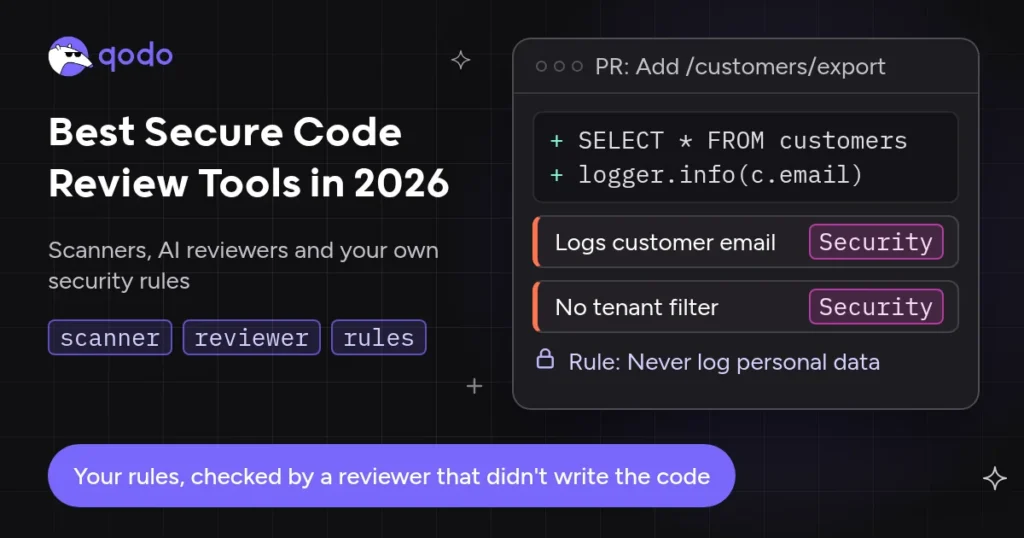
The same independent review carries your security rules into every PR, as our ranking of secure code review tools shows.
Qodo’s Context Engine Feeds the Agent Before It Writes and the Reviewer Before Merge
Qodo’s ingest agents parse every connected repository with AST chunking into a graph database, a vector database, PR and commit history and auto-generated summaries of modules and APIs. Deep research agents answer each query behind a ranking layer, and an MCP interface opens the engine to any agent (Context Engine docs; Qodo’s blog on how the engine works).
Before the agent writes, Qodo’s Agentic Toolbox gives the agent three skills through the CLI, MCP, Claude Code and Codex plugins or a Kiro Power:
- Codebase Wisdom answers questions across repositories and Git history.
- Get Rules loads the rules that apply to the task.
- Reviewer reviews local changes with the same engine as Qodo’s PR review.
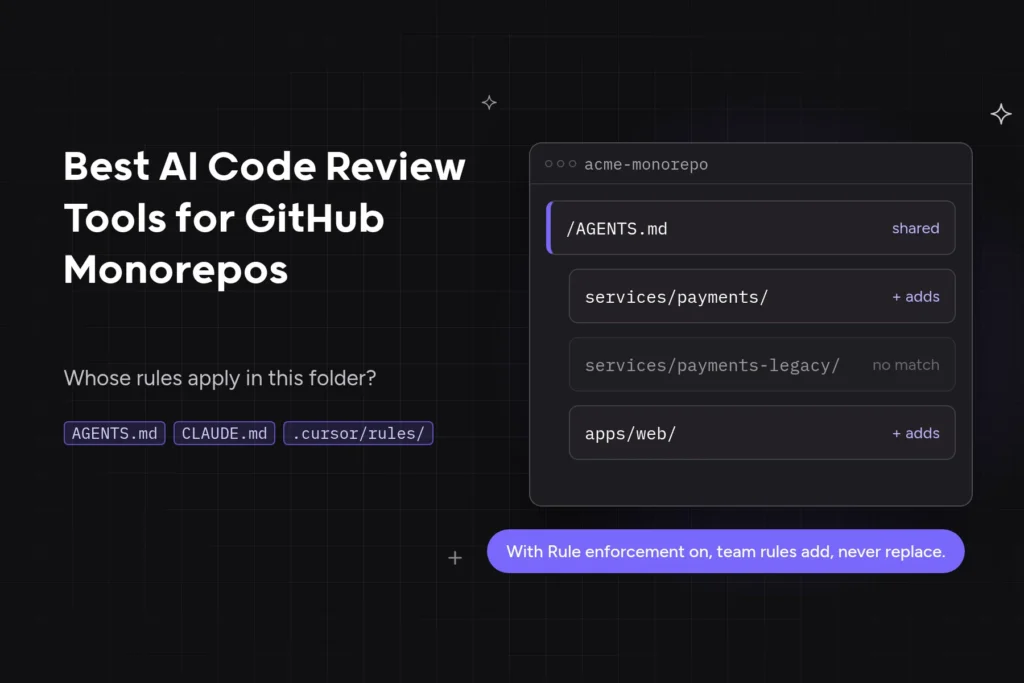
Before merge, Qodo reviews the PR against the same context. PR history, indexed for GitHub and GitLab, adds a Relevance section that links similar past PRs and shows how the team handled similar findings. Rule Miner (Beta) turns accepted, recurring review feedback into Review Standards rules that agents query through rules search. In a monorepo, those rules can be scoped to each team’s folder, as our guide to AI code review tools for GitHub monorepos explains.
Cross-repository code review (Beta) checks every relevant PR against Cross-repo relationships across Git providers, and flags a Cross-repo conflict (Beta), linked to the affected lines, when a change would break a related repository.

Qodo’s Software Map Shows Leaders What the Engine Knows
Qodo’s Software Map gives leaders a live view of dependencies, service relationships, contracts and blast radius across repositories, updated as PRs land, and admins choose which role can open the map. With Qodo 3.0, leaders see everyone’s work, trace every change and monitor progress across teams from the engine their agents and reviewers read.
How to Connect Qodo’s Context Engine to Your Coding Agent over MCP
The best MCP server for codebase intelligence and code review returns cross-repo dependencies, past PRs and team rules, not just files, and reviews changes before the PR exists. Qodo’s MCP server serves dependencies, past PRs and rules through the Agentic Toolbox and reviews local changes with the Reviewer skill, in Cursor, Claude Code, Codex, Kiro or any client that supports Streamable HTTP and custom request headers. The steps below follow the Qodo MCP setup.
- Create a personal API key. Generate a key in the Qodo portal and store it as the
QODO_API_KEYenvironment variable or in your client’s secret manager, never in source control. - Add the Qodo MCP server to your client. For Qodo’s SaaS deployment, the server URL is
https://sdk.qodo.ai/v1/tools/mcp/:
{
  "mcpServers": {
    "qodo-managed-tools": {
      "type": "http",
      "url": "https://sdk.qodo.ai/v1/tools/mcp/",
      "headers": {
        "Authorization": "Bearer ${QODO_API_KEY}"
      }
    }
  }
}
Keep the trailing slash: without it the server answers with a 307 redirect most clients don’t follow. Single-tenant and on-premises teams copy their own URL from the Qodo portal. To work from the terminal instead, install the Agentic Toolbox with curl -fsSL https://get.qodo.ai | sh (Node.js 20 or later) and list the tools with qodo tools.
- Reload the client and check the tool groups. After a restart, the agent sees Qodo’s tool groups, including codebase tools (
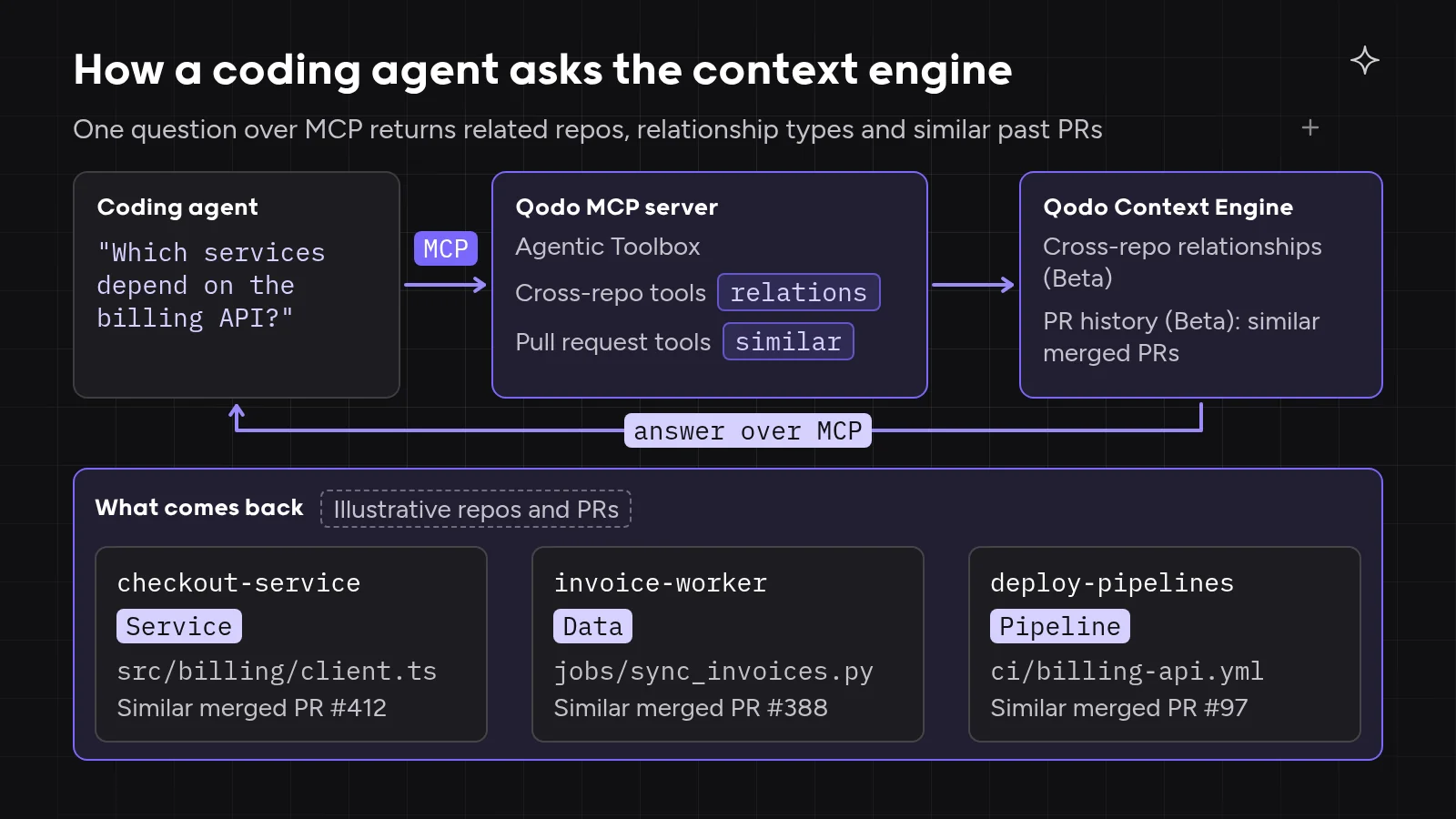
find,grep,read-file,blame,list-commits,search-repos), Cross-repo tools (overview,relations,pair), Pull request tools (details,patch,similar,review-history) and Rules tools (search,list,get). Which tools appear depends on your workspace access and permissions. - Ask a cross-repo question. Try “Which services depend on the billing API?” or “What would break if I changed this interface?”. The
relationstool returns related repositories with each relationship typed as Code, Service, Data, Pipeline, Docs or Other, andsimilarfinds similar merged PRs from PR history. In an illustrative answer,checkout-servicecalls the billing API,invoice-workerreads its data anddeploy-pipelinesships it, so the agent sees the blast radius before it edits a line.
- Load the rules and review before the PR. Ask for the rules that apply to the task through Get Rules, then run Reviewer on the local diff. After the push, cross-repository code review checks the PR against the main branch of each related repository by default; a link to a related branch or PR in the description points the check there instead.
Finish by pasting the default template from the Agentic Toolbox overview into your AGENTS.md file or CLAUDE.md. The template tells the agent to check Qodo’s codebase and PR knowledge before guessing about unfamiliar code or cross-repository impact, and to run the local review before opening a PR. Platform teams point their in-house agents at the same MCP server, as the Agentic Toolbox launch post describes.
Best Tools for Cross-Repo Context in Your Coding Agent
The best tool for cross-repo context gives a coding agent the dependency graph across repositories, so the agent sees a change’s blast radius before it edits a line. Codebase context for AI coding agents comes from three approaches: context inside the agent, code search and code graphs, and organization-wide context engines. Context inside the agent means instruction files such as CLAUDE.md plus search at task time, at zero setup cost, but the reach is one repository and the files drift.
Three tools cover the approaches that reach across repositories: Qodo as an organization-wide context engine, Sourcegraph for code search and codebase-memory-mcp for a local code graph. Structure pays off: Netflix’s agents given a headless IntelliJ engine were typically 20 to 30% more efficient, up to about 65% in the best case (Netflix and JetBrains, October 2026).
A tool for cross-repo context has to pass four tests: it builds a dependency graph across repositories, serves the graph over MCP to any coding agent, keeps the graph fresh as code changes, and gives the reviewer that checks the agent’s work the same context.
1. Qodo Serves One Cross-Repo Map to Every Coding Agent and to the Reviewer
Tool overview
Qodo‘s Context Engine indexes code, PR history and rules across every connected repository, and the Software Map turns Cross-repo relationships into a live map. Coding agents query the map over MCP before they write, and Qodo’s reviewer checks the PR against the same map before merge.
Main features
- Cross-repo relationships discovered automatically or added by your team, typed and managed across Git providers from one place
- Cross-repo tools (
overview,relations,pair) in the Agentic Toolbox MCP server, open to any MCP-compatible client and to the CLI - A Software Map that updates as PRs land, so agents read the current system rather than last quarter’s
- Cross-repository code review flagging a Cross-repo conflict when a change would break a related repository, while the Software Map shows leaders where findings concentrate
Best for
Organizations running several coding agents across many repositories and Git providers, where reviewers and engineering leaders need the same cross-repo context as the agents.
How it ranked
First. Qodo passes the dependency graph, MCP and freshness tests, and is the only tool here to pass the reviewer test: the Reviewer skill and cross-repository code review read from the same Context Engine as the agent.
2. Sourcegraph
Tool overview
Sourcegraph describes itself as a context layer for the codebase: code search, Deep Search and code navigation across repositories, open to agents through an MCP server.
Main features
- Keyword and semantic code search across repositories
- Go to definition and find references, with cross-repository support
- Commit and diff search, plus Deep Search for multi-step questions
- An MCP server on Enterprise plans, with OAuth, role-based MCP access and results limited to repositories the user may already read
Best for
Enterprises that need exhaustive code search and cross-repository references inside their coding agent.
How it ranked
Second. Sourcegraph passes the MCP test on Enterprise plans, covers cross-repository references through search and updates its index a few minutes after new commits. Sourcegraph’s context is code, commits and diffs without learned team rules, and the reviewer test depends on a separate tool reading separate context.
3. codebase-memory-mcp
Tool overview
codebase-memory-mcp is an open-source (MIT) MCP server that builds a persistent local knowledge graph of code, docs, configuration and infrastructure, that runs on your own machine with no API key. Version 0.12.1 shipped on October 16, 2026.
Main features
- 17 MCP tools, including call-path tracing with a cross-service mode
- A cross-repo intelligence mode that links HTTP, gRPC and async calls between indexed projects
- A background watcher that re-indexes watched git projects while an MCP session stays connected
- An installer that configures dozens of coding agents in one step
Best for
Individual developers who want a free, local code graph of a few related repositories, and platform teams testing what a homegrown graph covers before they build one.
How it ranked
Third. codebase-memory-mcp passes the dependency graph and MCP tests, and the freshness test while a session is connected. The graph lives on one machine with no PR history or team rules, and no reviewer reads it, so the reviewer test fails.
| Tool | Approach | Best for | Dependency graph across repositories | Served over MCP to any agent | Kept fresh as code changes | Same context at review |
| Qodo | Organization-wide context engine | Several agents across many repositories and Git providers | Yes, Cross-repo relationships across Git providers | Yes, Agentic Toolbox MCP and CLI | Software Map updates as PRs land | Yes, Reviewer skill and cross-repository code review |
| Sourcegraph | Code search across repositories | Enterprise code search and cross-repository references | Cross-repository search and references | Yes, Enterprise plans | Index updates minutes after new commits | Separate tool |
| codebase-memory-mcp | Local code graph | A free local graph of a few related repositories | Yes, cross-repo mode across indexed projects | Yes, local server | Watcher while a session is connected | No |
Context Engine vs RAG vs Context Engineering
Retrieval-augmented generation (RAG) is a technique, a context engine is a system, and context engineering is the discipline of deciding what goes into the window.
| Term | What it is | Example in a coding workflow |
| RAG | A technique that fetches snippets and adds them to the prompt | Embedding search returns five similar functions for the agent’s prompt |
| Context engine | A system that combines retrieval with a code graph, history, rules, permissions and ranking, and serves the result to agents | The agent asks which services call an API and gets ranked repositories, files and past PRs |
| Context engineering | The practice of choosing what each agent sees, in what order and within what budget | A platform team decides agents load team rules before code and cap each answer at a fixed token budget |
Context engineering for coding agents is the job; a context engine does the job at scale. Bigger windows retire neither: the Codebase-Memory paper showed a graph matching most of a file-reading agent’s quality at a tenth of the tokens.
My Experience Asking Each Tool the Same Shared-Library Question
I put one question to the docs, configuration references and changelogs of every tool in this guide in October 2026: if a PR renames a function in a shared library, who tells the agent and the reviewer about the three services that call it?
Sourcegraph answers the agent half through cross-repository find-references, and its index updates a few minutes after new commits. Review of the PR stays with a separate tool reading separate context.
codebase-memory-mcp traces call paths across indexed projects on one machine. The watcher re-indexes a git project only while the MCP session that registered the project stays connected, skips plain directories by default, and a reindex that rebuilds the graph drops the cross-repo links until linking runs again.
Qodo answers both halves. The agent asks Codebase Wisdom “What would break if I changed this interface?” before writing, and if the rename still breaks a caller, the PR gets a Cross-repo conflict finding linked to the affected lines in the other repository. Cross-repository review compares against each related repository’s main branch unless the PR description links the matching branch or PR.
Two details decide whether day one works. The trailing slash on Qodo’s MCP URL separates a working connection from a silent 307. Rule Miner and Relevance wait for a minimum amount of indexed PR history, shown in the repository sidebar’s “What this unlocks” panel, so a new repository starts with code context and learned rules follow as history builds.
Summary
A context engine decides what an AI coding agent sees through six functions: retrieval, graph building, permissions, conflict resolution, token budgeting and the same context for review and governance. For cross-repo context, Qodo suits organizations with many agents and repositories, Sourcegraph suits enterprises that need exhaustive code search, and codebase-memory-mcp suits individual developers who want a free local graph. Qodo ranks first because the coding agent, the reviewer and engineering leaders all read from one Context Engine.
FAQ
What is the best MCP server for codebase intelligence and code review?
The best MCP server for codebase intelligence and code review exposes cross-repo code, PR history and team rules, and reviews changes before the PR exists. Qodo’s MCP server works in any MCP-compatible client and gives the agent Codebase Wisdom, Get Rules and Reviewer, as the glossary on the MCP server for review explains.
What’s the best tool for cross-repo context in my coding agent?
The best tool for cross-repo context builds a dependency graph across repositories, serves the graph over MCP to any agent, keeps the graph fresh and gives the reviewer the same context, and the same test decides which tool covers a whole repository. Qodo maps cross-repo context as Cross-repo relationships across Git providers, updates the Software Map as PRs land and serves the map through Codebase Wisdom, and cross-repository code review checks each PR against the same relationships.
Does retrieval stay accurate across hundreds of repositories?
Retrieval stays accurate across hundreds of repositories when the engine narrows the search to related repositories and ranks evidence before the agent sees it, not when the index simply grows. Qodo runs each query through deep research agents and a ranking layer, guided by the relationships between repositories.
Should we build our own context engine or buy one?
Building your own context engine means owning parsing, the code graph, embeddings, history, permissions and an MCP layer, and keeping each piece current. Qodo exposes its Context Engine over MCP and the CLI, so in-house agents use the engine without a rebuild.
How do coding agents learn team rules without copying legacy code?
Coding agents learn team rules without copying legacy code when the rules come from recent review decisions instead of the oldest files. Qodo’s Rule Miner turns accepted, recurring PR feedback into coding agent rules in Review Standards, and Get Rules hands the rules that apply to the agent before it writes.
How does a context engine handle permissions?
A context engine should return only what the requesting user or agent is allowed to read. In Qodo, the skills and tools available to an agent follow the user’s workspace access and permissions, and admins choose which role can view the Software Map.
Do bigger context windows replace a context engine?
Bigger context windows don’t replace a context engine, because a large codebase still exceeds any window and extra noise lowers answer quality. Qodo sends the agent the ranked slice of code, history and rules a task needs instead of whole repositories.
Ethical use of AI
We use AI to proofread and organise our ideas. The substance comes from our team of developers and technical experts: every fact is traced back to its original source, and every example is hand-crafted and tested.
About the author