Best Claude Code Skills for Code Review in 2026: 5 Agent Skills Worth Installing

Claude Code skills turned code review into a one-command habit, but the skill you install decides what actually gets checked. The list below compares five review skills by what runs the review, what context it sees and whether your team’s standards still hold when the pull request (PR) opens. Teams get agent code merged sooner with fewer rollbacks: high-velocity teams get the review skills they already use checked on every PR, and enterprise engineering teams get the same standards enforced across every repository.
TL;DR
- Agents do not reliably follow written standards. Only 34.6% of developers said coding agents always follow organizational standards, according to the Qodo State of AI Code Quality 2026. A review skill that is only a prompt inherits the same gap.
- The bundled
/code-reviewis a strong free default. Anthropic ships the skill with Claude Code on every plan, and it checks the current branch for correctness bugs before you push. - Qodo reviews every Claude Code change with its own review engine and cross-repo context, so teams fix issues before the PR and merge sooner with fewer review rounds. High-velocity teams get the SKILL.md files they already keep checked on every PR, and enterprise engineering teams get the same team skills enforced across many repos and coding agents.
- Open-source review skills cover focused jobs. Pick mattpocock’s skill for spec checks, Trail of Bits for security diffs and Superpowers for handling review feedback.
The 5 Best Claude Code Skills for Code Review
- Qodo Agentic Toolbox: engine-backed review with cross-repo context and team skills checked on PRs.
- Claude Code /code-review: quick correctness review of a branch on any Claude plan.
- mattpocock code-review skill: checks a branch against repo standards and the originating spec.
- Trail of Bits differential-review: security-first review of risky diffs.
- Superpowers code review skills: review checkpoints inside a plan-driven agent workflow.
| Claude Code skill | Best for | What runs the review | Team standards | Where code review runs |
| Qodo Agentic Toolbox | High-velocity teams that want their skills checked on every PR, and enterprise teams that want the same skills across many repos | Qodo review engine | Imported SKILL.md files and Review Standards, checked on PRs | Local diff and PR |
| Claude Code /code-review | Quick correctness review of a branch | Claude Code subagent | Follows CLAUDE.md | Local branch, or comments on a GitHub PR or GitLab merge request |
| mattpocock code-review | Branch checks against repo standards and the spec | Parallel Claude Code subagents | Reads the repo’s documented standards | Diff since a fixed point |
| Trail of Bits differential-review | Security-focused review of risky diffs | Claude Code session | Security checklist inside the skill | PR, commit or diff |
| Superpowers code review skills | Review checkpoints in a plan-driven workflow | Claude Code reviewer subagent | Reviews against the plan | Between tasks and before merge |
What Claude Code Skills Are and Where They Live
A Claude Code skill is a folder with a SKILL.md file. The file opens with YAML frontmatter holding a name and a description, followed by plain instructions and any supporting files the skill needs. Claude loads a skill when the description matches the task, or you run the skill directly with /skill-name, as the Claude Code skills docs explain.
Claude Code reads skills from four places: personal skills in ~/.claude/skills/, project skills in .claude/skills/, plugin skills and organization skills pushed through managed settings. Project skills travel with the repository, so everyone who clones the repo gets the same review instructions.
Claude Code skills follow the Agent Skills standard, an open format that other coding agents also read. A review skill written once can run in Claude Code, Codex and any other agent that supports agent skills.
Bundled skills such as /code-review ship with Claude Code, and a project skill named code-review replaces the bundled one. A plugin is a marketplace bundle that can carry skills, commands and hooks, as the entry on Claude Code plugins explains.
What Is the Best Claude Code Skill for Code Review?
The best Claude Code skill for code review is the one that checks your change with a dedicated review engine, sees past the diff and holds your team’s standards on the PR. I compared every skill on five criteria, in this order:
- Review engine behind the skill. A prompt asks the coding agent to review its own work. An engine-backed skill sends the diff to a separate review system.
- Context beyond the diff. Review quality depends on other repositories, past PRs and the intent behind the change.
- Team standards before and on the PR. The same rules should guide the agent while it writes and the review when the PR opens.
- Loop from local review to PR findings. Findings from the PR should come back into the session that wrote the code.
- Governance across repositories. Someone needs to see which skills run where and what they catch.
Qodo is the best choice for code review in Claude Code because Qodo’s review skill sends the diff to Qodo’s review engine, the engine reads other repositories and PR history, and Qodo checks your team’s own SKILL.md files again on every PR. Context is the gap most teams feel: 18.7% of engineering leaders in Qodo’s 2026 survey said AI review tools still miss context-specific or architectural violations.
High-velocity teams get findings while the code is still in the session. Enterprise engineering teams get one place to see which review skills run in which repositories.
Claude Code Skills for Code Review: The 5 Picks
Qodo Agentic Toolbox
Tool overview
The Qodo Agentic Toolbox gives Claude Code access to Qodo’s code understanding, coding standards and review engine through a Claude Code plugin. The plugin installs five skills: Reviewer (run in Claude Code as pre-pr-review), Review Resolver, Codebase Wisdom, Manage Standards and the optional Get Rules skill. The same skills run in Codex, Kiro and any MCP client, and the hub guide to the best MCP servers covers the MCP side of codebase context.
Main features
- Review before the PR. The Qodo Reviewer skill checks committed, uncommitted and untracked changes with the same engine as Qodo’s PR review.
- Intent goes into the review. Reviewer takes a session summary, key decisions and ticket or spec links, so a deliberate choice does not come back as a finding.
- Cross-repo context. Codebase Wisdom gives the agent repository relationships, the impact of a change and earlier implementations of similar code.
- PR findings back in the session. Review Resolver pulls Qodo’s PR findings into Claude Code, and every finding ends as fixed, skipped with a reason, or reported.
- Team skills checked on PRs. Qodo can manage team skills by importing SKILL.md files from your repositories and applying each one in PR review as Rules enforcement or Skill steering.
- Per-skill numbers. The Skills page shows how many PRs triggered each skill, how many violations it detected and how many PRs merged with violations still open.
- Rules before the first line. Get Rules hands the agent the rules that apply to the task before it writes code.
Best for
Teams that want Claude Code changes merged sooner with fewer rollbacks. High-velocity teams get the review skills they already use checked on every PR, with a plugin install and no new process. Enterprise engineering teams get the same team skills enforced across many repos and coding agents, with per-skill numbers on what each skill caught.
How it compares
Qodo is the only skill in the comparison that covers the five criteria from engine to governance. A supporting point: you can’t review code with the same tool that wrote it, and Qodo’s engine sits outside the coding agent’s session.
Claude Code /code-review
Tool overview
Anthropic ships /code-review as a bundled skill in Claude Code. The skill reviews the current branch for correctness bugs and, depending on the model and effort level, also suggests reuse and efficiency cleanups.
Main features
- Effort levels from
lowtomax, plusultrafor a deeper review in the cloud. --fixapplies fixes, and--commentposts findings on a GitHub PR or a GitLab merge request.- Runs as a subagent with its own context and follows the project’s CLAUDE.md, on any Claude plan.
Best for
Developers who want a quick correctness check of a branch before they push.
How it compares
Claude Code’s /code-review is strong on the local loop and costs nothing extra. Context stops at the repository, team standards come from CLAUDE.md, and there is no cross-repo governance. Anthropic also sells a managed review service for Team and Enterprise plans on GitHub.
mattpocock code-review skill
Tool overview
The code-review skill in the open-source mattpocock/skills repository (MIT license) reviews changes since a fixed point on two axes: the repo’s standards and the spec that started the work.
Main features
- Runs parallel subagents, each with fresh context, one per axis.
- Finds the spec from issue references in the commit history.
- Installs through the official Claude plugin marketplace or skills.sh.
Best for
Developers who want a branch checked against the repo’s documented standards and the originating issue or spec.
How it compares
The mattpocock skill gives good spec and standards checks inside one repository. The review runs as instructions in the session, with no PR-side check and no record of what the skill caught.
Trail of Bits differential-review
Tool overview
differential-review is a security-focused review skill from the Trail of Bits skills marketplace for Claude Code and Codex, published under CC BY-SA 4.0.
Main features
- Risk-first review of PRs, commits and diffs.
- Reads git history to spot regressions in code that changed before.
- Checks whether tests cover the modified code and writes a markdown report.
Best for
Security reviews of risky changes such as authentication, cryptography and external calls.
How it compares
Trail of Bits goes deep on security within one repository and its history. The skill has no cross-repo context and no team standards layer.
Superpowers code review skills
Tool overview
requesting-code-review and receiving-code-review are two skills in the open-source Superpowers framework (MIT license), available in the official Claude plugin marketplace.
Main features
requesting-code-reviewsends a reviewer subagent curated context and reports issues by severity.receiving-code-reviewmakes the agent weigh each piece of feedback before it changes code.
Best for
Developers who run plan-driven agent workflows and want review checkpoints between tasks.
How it compares
Superpowers brings good discipline to the review loop. The skills review against the plan rather than team standards, and nothing checks the PR afterwards.
How We Compared These Claude Code Skills
I read each skill’s SKILL.md, README and official docs on 2 Nov 2026 and compared every skill on the five criteria from the answer section. Install counts and stars were left out, because installs measure popularity rather than review quality.
| Criterion | Qodo | /code-review | mattpocock | Trail of Bits | Superpowers |
| Review engine behind the skill | Strong (Qodo review engine) | Partial (Claude subagent) | Partial (Claude subagents) | Partial (Claude session) | Partial (Claude subagent) |
| Context beyond the diff | Strong (cross-repo, PR history) | Partial (repo) | Partial (repo, spec) | Partial (repo, git history) | Partial (plan) |
| Team standards before and on the PR | Strong (Get Rules, PR review) | Partial (CLAUDE.md, local) | Partial (local) | Not covered | Not covered |
| Loop from local review to PR findings | Strong (Reviewer, Review Resolver) | Partial (--comment) |
Not covered | Partial (report) | Partial (feedback skill) |
| Governance across repositories | Strong (Skills page, scope, metrics) | Not covered | Not covered | Not covered | Not covered |
When to Use a Review Prompt, a Review Skill or a Review Tool
A one-off review prompt suits a throwaway check. Typing “review this diff for null handling” costs nothing, but nobody else on the team runs the check, and the prompt disappears with the session.
A review skill suits a check the whole team repeats. A SKILL.md file in .claude/skills/ gives every developer the same instructions, and Claude loads the skill when the task matches. The agent still decides how closely to follow the instructions.
A review tool suits checks that must hold on every PR. A dedicated engine such as Qodo runs the check outside the coding agent, reads other repositories and records what each rule caught. In my experience, most teams end up with all three: prompts for quick questions, skills for team habits and a review tool for the standards that cannot slip.
Where Claude Code Review Skills Broke Down: 3 Examples
The three examples below are illustrative composites based on patterns we hear on customer calls. No real company, figure or quote is used.
Code review skill example 1: every developer had a different skill
A high-velocity team shipped most changes through Claude Code, and each developer had installed a different review skill. Sessions looked thorough, yet the same error-handling convention kept slipping into PRs, because only some of the skills checked for the convention.
The team moved its review skill into a shared repository, imported the skill into Qodo and applied it as Rules enforcement. Qodo then checked the error-handling convention on every PR, whichever skill a developer used locally.
Code review skill example 2: a config skill nobody ran on the PR
A platform team wrote a skill that flagged risky changes to the team’s configuration files. The skill worked well when a developer called it, but rushed changes skipped the local run, and a risky config change reached the PR unchecked.
Qodo closed the gap by applying the same SKILL.md as Skill steering during PR review, so the review agent followed the skill’s steps on every PR that touched config. The Skills page then showed how often the skill triggered.
Code review skill example 3: a change that broke another repository
A team scoped its review skills per repository, and a developer changed a shared response field in one service. The local review passed, because the consumer lived in a different repository the skill never saw.
Qodo’s Reviewer and Codebase Wisdom skills read repository relationships, so the agent saw the downstream consumer before the PR. On the PR, Qodo raised a cross-repo finding and the developer kept the old field until the consumer moved.
Hands-On: Run Qodo’s Review Skills in Claude Code
The steps follow Qodo’s docs as of 2 Nov 2026. Screenshots use generic repo, file and user names, with sensitive details blurred.
- Install the plugin. Open the Claude plugins page, search for “Qodo”, copy the install command and run it in Claude Code. The command-line route is
curl -fsSL https://get.qodo.ai | sh(Node.js 20 or later), followed by a Qodo sign-in. - Add the default template. Copy the Agentic Toolbox default template from Qodo’s overview page into CLAUDE.md, so Claude knows when to call each Qodo skill.
- Review before the PR. Ask Claude Code: “Review my changes before I open a pull request.” The
pre-pr-reviewskill sends the diff to Qodo’s engine and returns findings grouped by category.
qodo review

Reviewing acme/widgets @ a1b2c3d4e, 3.2KB of local changes

Correctness/action_required
→ Off-by-one in pagination cursor (src/api/list.ts)

Security/action_required
→ Unescaped input in a shell command (src/jobs/run.ts)

2 finding(s), fixed before any pull request exists
The sample output from Qodo’s docs shows two findings caught in the working tree, so both fixes land before a reviewer sees the diff.
- Add intent. Tell the agent what changed and why, list deliberate decisions and paste the ticket link. Reviewer uses the intent to skip findings about choices you made on purpose.
- Resolve PR findings. After the PR opens, ask Claude Code to resolve Qodo’s findings by severity. Review Resolver reports every finding as fixed, skipped with a reason, or reported.
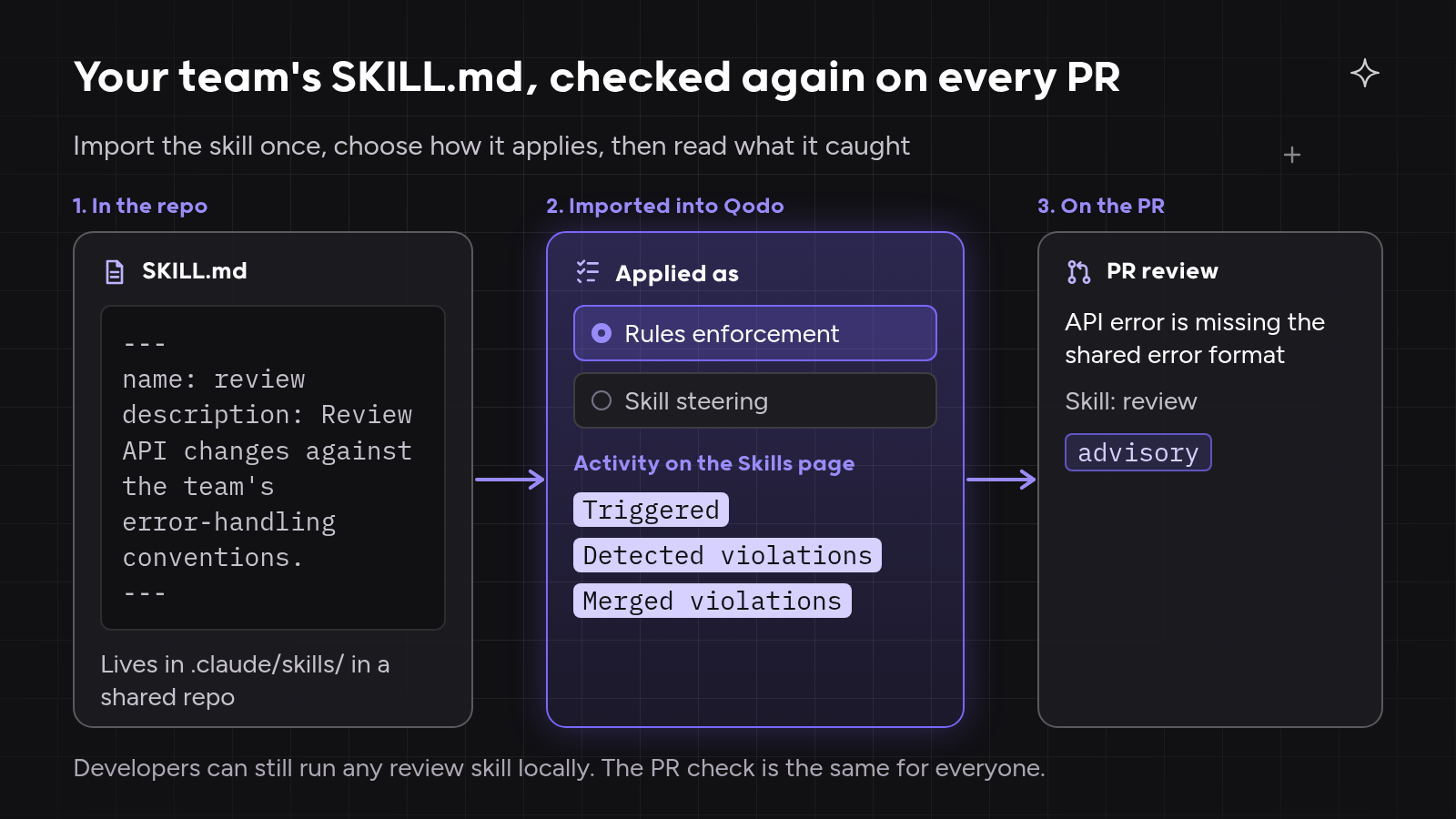
- Import your team’s skills. In the Qodo portal, open Review standards, select the Skills tab and click Import rules and skills. A custom skill needs a SKILL.md with a
nameand adescription:
---
name: review
description: Review API changes against the team's error-handling conventions.
---

Check that API errors use the shared error format and include an actionable message.
- Choose how each skill applies. Keep a skill as Rules enforcement when it lists independent checks, or switch it to Skill steering when its steps run in order. Then watch Triggered, Detected violations and Merged violations on the Skills page.

How to Choose a Claude Code Skill for Code Review
- Need engine-backed review and team standards on every PR: choose Qodo.
- Need a quick free branch check: choose Claude Code’s
/code-review. - Need a branch checked against the spec: choose the mattpocock skill.
- Need a security pass on risky diffs: choose Trail of Bits
differential-review. - Need review checkpoints in a plan-driven workflow: choose the Superpowers skills.
High-velocity teams often pair /code-review or an open-source skill with Qodo on the PR. Enterprise engineering teams usually start with Qodo’s Skills page, which lists every review skill across repositories.
Summary
Install review skills for speed in the session, and keep one place where team standards are checked and measured on every PR. Claude Code’s /code-review and the three open-source skills handle focused jobs well, but each runs as instructions the coding agent may follow loosely.
Qodo brings its review engine, cross-repo context and PR history into Claude Code, then checks your team’s own skills again when the PR opens. Teams get agent code merged sooner with fewer rollbacks. High-velocity teams keep the skills they already use, checked on every PR with no new process, and enterprise engineering teams enforce the same team skills across many repos and coding agents. For how review agents work in general, read Qodo’s guide to AI code review.
FAQs
What are Claude Code skills?
Claude Code skills are folders with a SKILL.md file that tells Claude how to do a task, loaded when the description matches or run with /skill-name. Qodo ships its review, findings and codebase context skills for Claude Code through the Qodo plugin.
What is the difference between a regular Claude skill and Qodo’s review skill?
A regular Claude skill is a list of instructions the coding agent reads and follows inside its own session. Qodo’s review skill sends the diff, untracked files and your stated intent to Qodo’s review engine, which returns structured findings from outside the session that wrote the code.
Can coding agents ignore the rules in a skill?
Coding agents can ignore or partly follow the rules in a skill, because skill instructions are advisory. Only 34.6% of developers in Qodo’s 2026 survey said agents always follow organizational standards. Qodo checks the same standards again in PR review and shows which rules were violated.
What does a code review tool catch that a coding agent cannot?
A code review tool catches issues that need context the coding agent never loaded, such as a consumer in another repository or a pattern the team rejected in past PRs. Qodo reads repository relationships and PR history, so its findings include cross-repo impact the session could not see.
Can I replace the bundled /code-review skill with my own?
You can replace the bundled /code-review skill by adding a project skill named code-review in .claude/skills/. Claude Code then runs your skill for that repository. Teams that want their custom review checked on every PR can import the same SKILL.md into Qodo.
Which AI code review tools support Agent Skills?
Several AI code review tools now read SKILL.md files, and Qodo supports agent skills in two directions. Qodo’s own review skills run in Claude Code, Codex, Kiro and any MCP client, and Qodo imports your team’s SKILL.md files into PR review with per-skill activity numbers.
Do review skills work per repo or across the organization?
Review skills in .claude/skills/ work per repository by default, and personal skills work per developer. Qodo imports skills from many repositories, lets admins choose the repositories where each skill applies and shows where every skill triggered, so one skill can cover the whole organization.
Ethical use of AI
We use AI to proofread and organise our ideas. The substance comes from our team of developers and technical experts: every fact is traced back to its original source, and every example is hand-crafted and tested.
About the author