Best Code Review Tools for Distributed Teams in 2026

Distributed engineering organizations lose consistency before they lose time: each office and contractor group drifts toward its own review rules, and leaders can’t see what’s waiting outside their own office. Time-zone waits make each of those gaps worse. We rank the five best code review tools for distributed teams on four criteria that each tool can fail, and end with a hands-on setup for one review standard across two offices.
TL;DR
- Distributed review is the everyday case. Only 18% of developers go into an office every day, so most pull requests (PRs) reach a reviewer the author can’t walk over to (Stack Overflow’s 2026 survey, October 6, 2026).
- Shared standards break first. 35.1% of developers and engineering leaders say their organization has documented standards, but enforcement varies by team or repository (Qodo’s survey run by Censuswide, August 2026, AI code quality report). A template repository that every service forks drifts after the first copy.
- The handoff costs more than the code review. A blocking question took a median 19 hours to resolve on teams with no shared working hours, against 3 hours on teams with four hours of overlap (Engagetal’s overlap study, March 2026).
- Qodo is the best code review tool for distributed teams, because one Qodo workspace holds offices on GitHub, GitLab, Bitbucket, Azure DevOps and Gerrit to one organization-owned rulebook. Through Qodo 3.0, leaders get one view of every team’s findings and review queue.
- The others each cover part of the job. GitHub and GitLab route each PR to its owners and enforce merge rules, Gerrit makes the next turn clear, and Graphite keeps PRs small enough to read in one sitting.
What Makes the Best Code Review Tools for Distributed Teams?
The best code review tools for distributed teams hold every office to one standard and show leaders what every office is doing. Any cloud reviewer runs while an office sleeps, so each criterion below tests something a distributed organization loses first.
Four Criteria a Code Review Tool Can Fail Across Offices
- One organization-owned rule set, with recorded outcomes. Rules written once apply in every repository, office and contractor group, with scoped local adjustments, and every finding ends as a fix or a dismissal with a recorded reason. Rules read only from files inside each repository fail, because every office’s copy drifts.
- One leader view across offices. Leaders see every team, trace every finding and monitor progress across repositories and Git providers in one place, including which team’s review queue is backing up. One dashboard per repository fails, because leaders can’t compare offices whose numbers were never collected the same way. Only 42% of engineering leaders say they have the right metrics to separate real AI gains from activity, according to a self-reported survey (October 20, 2026, Atlassian State of Developer Experience 2026).
- Cross-repository context. A reviewer in one office often judges another team’s code, so the tool reads related repositories, services and contracts. A reviewer limited to the diff or one repository fails. When developers need a specific answer, 72% turn to the people they work with (Stack Overflow’s 2026 survey, October 6, 2026), and on a distributed team that person often sits in another office.
- Review on PR open, with written context. Review starts the moment a PR opens, so the author fixes findings before signing off, and a summary of intent travels with the PR to the next office in place of the overnight “what does this do?” comment. A reviewer someone has to trigger fails. “Slow first response is the most common cause of PR queue buildup,” according to Qodo’s governance guidelines.
Case study: A Fortune 100 retailer saw cross-region code reviews slow developer velocity
A Global Fortune 100 retailer found that “code reviews across regions slowed developer velocity, as distributed teams struggled with consistency and communication” (Qodo customer story, September 15, 2025).
Qodo Gives Every Office One Rule Set and Leaders One View of Every Team
Choose Qodo if offices and contractor groups drift from your standards, because Qodo enforces one organization-owned rulebook in every repository and records per rule which violations merged. Through Qodo 3.0, leaders see every office in one view.
Case study: LoopUp unified code review standards across London, San Francisco and Jakarta
Qodo replaced what LoopUp’s case study calls “no unified system enforcing shared standards” across hundreds of repositories for teams in London, San Francisco and Jakarta (LoopUp case study, April 29, 2026).
Agent-written PRs reach reviewers in every office, and you can’t review code with the same tool that wrote it. One independent reviewer checks every agent’s output against the same rules, whichever agent each office prefers.
To manage coding-agent rules centrally across teams, keep one organization-owned rule source that every coding agent and the reviewer read, and let each team add scoped rules on top. Qodo holds that source in its Rules tab, imports AGENTS.md and CLAUDE.md files into it and checks every PR against the result.
The 5 Best Code Review Tools for Distributed Teams
Ranking by Shared Standards, Leader Visibility and Context
- Qodo: independent review and governance across every office
- GitHub pull requests: code owners and organization rulesets
- GitLab merge requests: Code Owners and group approval policies
- Gerrit: open-source review built around whose turn it is
- Graphite: stacked PRs and a merge queue, part of Cursor
Comparison Table: Code Review Tools for Distributed Teams at a Glance
| Tool | Category | Git providers | Best for |
| Qodo | Independent review layer | GitHub, GitLab, Bitbucket, Azure DevOps, Gerrit | Holding every office to one rule set and one leader view |
| GitHub pull requests | Built-in platform review | GitHub | Requesting each path’s owners and one set of merge requirements |
| GitLab merge requests | Built-in platform review | GitLab | Group-wide approval requirements kept outside each project |
| Gerrit | Workflow tool | Gerrit | Self-managed review with a strict whose-turn-is-it handoff |
| Graphite | Workflow tool | GitHub | Splitting large changes into stacked PRs readable in one sitting |
Code Review Tools for Distributed Teams, by Category
The code quality tools that work best for distributed teams check the same standards at review time in every repository, while static analysis covers deterministic checks in the build. “Code review tool” covers three different jobs, and a distributed team often pairs two of them, as Qodo’s guide to the code review tool stack shows.
Three Categories of Code Review Tools
- Independent review layer (Qodo). Review, rules and governance are Qodo’s whole product, so every office keeps one reviewer and one rule set whichever coding agent each team uses.
- Built-in platform review (GitHub pull requests, GitLab merge requests). The Git provider decides who must approve and what blocks a merge, through code owners, rulesets and approval policies.
- Workflow tools (Gerrit, Graphite). Workflow tools shape the turn order or the stack and pair with a reviewer. Graphite became part of Cursor on December 19, 2025.
How We Evaluated Code Review Tools for Distributed Teams
We built the criteria from questions engineering leaders with offices on several continents bring to Qodo: how to keep one standard after an acquisition, why cross-team reviews queue on a few busy teams and what leaders can compare across offices. We checked each criterion against vendor documentation, configuration references and changelogs in October 2026.
Code Review Tools for Distributed Teams Scored on Four Criteria
| Tool | One rule set, recorded outcomes | One leader view | Cross-repository context | Review on open, written context |
| Qodo | Organization rules (Beta), recorded dismissals | Software Map (Beta), code review analytics (Beta), PR Triage (Research Preview) | Context Engine, cross-repository review (Beta) | Automatic, with PR summary |
| GitHub pull requests | Org rulesets for merges; standards stay with reviewers | None across offices | Repository | Code owners requested |
| GitLab merge requests | Group approval policies; standards stay with approvers | None across offices | Project | Code Owners required |
| Gerrit | None built in | “Your turn” dashboard | Revision history | No AI review |
| Graphite | From the paired reviewer | Stack and queue status | Small stacked PRs | Pairs with a reviewer |
My Experience Following One Rule From London to Jakarta
I followed one rule, “every change to a public API updates its OpenAPI contract,” from a London repository to a Jakarta one through each tool’s configuration references and changelogs. The question that split the tools was where the rule lives and who can loosen it.
On GitHub, organization rulesets can only get stricter at repository level, and CODEOWNERS is read from the PR’s base branch, so a PR can’t reroute its own reviewers. The OpenAPI rule itself has no home there, so each office’s reviewers carry the rule in their heads. On GitLab, approval policies sit in a separate security policy project and cover whole groups, yet they decide who approves, not what the approver checks.
In Qodo, the rule is written once in the Rules tab with the Global scope and reaches the GitHub and GitLab offices alike, while a merged AGENTS.md in Jakarta adds payments rules without touching the shared one. The template-fork pattern is where per-repository rule files fail: each fork copies the file once, and every office’s copy drifts from the first commit.
Two settings I’d check before the first office goes live. Qodo skips PRs opened by bots by default, so a team whose coding agents open PRs sets ignore_bot_pr = false. “Today” in Qodo’s code review analytics starts at midnight UTC for every office, so London and Jakarta report the same window.
The Best Code Review Tools for Distributed Teams, Reviewed
1. Qodo Holds Every Office to One Code Review Standard and Shows Leaders Every Queue
Tool overview
Qodo is the independent code review layer for teams spread across offices and time zones, with one rulebook on every Git provider they use. Qodo reviews what any coding agent writes, whether Copilot, Cursor, Claude Code or Codex, and stays separate from all of them. One Qodo workspace reviews GitHub, GitLab, Bitbucket, Azure DevOps and Gerrit, so offices on different Git providers, including teams that arrive through an acquisition, share one reviewer and one rule set.
Main features
- Organization rules that apply to every connected repository by default and scope down by Git organization, repository or path once Rule enforcement is on, with rules that members propose waiting in Pending rules for admin approval
- Rule Miner (Beta) turning repeated review comments into rules, weighting each reviewer by ownership of the changed code, plus rule imports from AGENTS.md and CLAUDE.md files
- Qodo 3.0 leader view: Software Map, code review analytics by repository and PR author for admins, rules analytics showing how often each rule is violated and resolved before merge, the Findings page (Beta) and PR Triage with a review service level agreement (SLA) in days
- Context Engine reasoning across related repositories, with cross-repository review flagging changes that break another team’s repository
- Advisory findings that authors fix or dismiss with a recorded reason, while your branch protection decides what merges; Previous reviews keeps every review run per commit
- Automatic review as soon as a PR is opened, reopened or marked ready for review, with a PR summary of intent, a walkthrough and a review time estimate (PR summary docs), and Chat with Qodo in the PR to explain any finding (Beta)
Best for
Engineering organizations with several offices or contractor groups that need one rule set enforced in every repository, and leaders who want to see and trace every office’s findings and queue in one place.
How it ranked
Qodo met every criterion, and the shared rule set decided the ranking: one rule written in the portal reaches GitHub and GitLab offices alike, each office’s AGENTS.md adds local rules on top, and code review analytics group findings by repository and PR author.
2. GitHub Pull Requests With Code Owners and Rulesets
Tool overview
GitHub’s built-in pull request review, where a CODEOWNERS file names who reviews each path and rulesets define merge requirements.
Main features
- CODEOWNERS requests review from the owners of changed files when a PR is ready for review, using the file on the PR’s base branch
- “Require review from Code Owners” in branch protection or rulesets, where one owner’s approval satisfies each path
- Organization rulesets on GitHub Team and Enterprise plans that target all repositories or a filtered list, editable only by organization owners
Best for
Organizations on GitHub that want each path’s owners requested automatically and the same merge requirements in every repository.
How it ranked
Organization rulesets hold merge requirements steady across repositories, and repository rulesets can add restrictions but never remove them. Review standards stay with the people reviewing, and each repository keeps its own CODEOWNERS file. Reading the docs, I’d give the CODEOWNERS file an owner of its own, as GitHub recommends, so nobody reroutes reviews by editing it.
3. GitLab Merge Requests With Code Owners and Approval Policies
Tool overview
GitLab’s built-in merge request review, with Code Owners on Premium and Ultimate and merge request approval policies on Ultimate.
Main features
- One CODEOWNERS file per project, compared against the target branch, with required Code Owner approval on protected branches
- Approval rules for expertise that doesn’t map to paths, such as a security team
- Merge request approval policies scoped to groups or projects and stored in a separate security policy project, with settings such as blocking authors from approving their own merge requests
Best for
Organizations on GitLab Ultimate that want approval requirements written once for a group and kept outside each project.
How it ranked
Approval policies apply one approval standard across a group’s projects. Each policy decides who approves, while the review itself depends on each approver, and GitLab caps each policy project at five merge request approval policies. For an AI reviewer on top of either platform, see our comparison of agentic AI code reviewers for GitHub and GitLab.
4. Gerrit
Tool overview
Gerrit is an open-source code review system built around changes and their revisions.
Main features
- An attention set that answers “Whose turn is it?” on every change
- A “Your turn” dashboard with a Waiting column showing how long the owner has waited
- Guidance to reply within about 24 hours
Best for
Self-managed review with a strict whose-turn-is-it handoff that shows how long each change has waited.
How it ranked
Gerrit has no AI review of its own, so first review and shared standards come from the reviewer you add, and Qodo brings that first review to Gerrit changes.
5. Graphite
Tool overview
Graphite is a PR workflow tool for stacked PRs and a merge queue, part of Cursor since December 2025.
Main features
- Stacked PRs that split large changes into small, reviewable steps
- A merge queue that lands each PR in order
- A PR inbox that shows each stack’s status
Best for
Splitting large changes into small stacked PRs that a reviewer in another office can read in one sitting.
How it ranked
Graphite keeps PRs small, and a small PR raises fewer questions overnight. Shared standards and an organization-wide view come from the reviewer you pair with Graphite, and coverage is GitHub only.
How Distributed Teams Keep Code Review Moving Across Time Zones
Distributed teams keep code review moving by settling the handoff before the PR opens: who reviews first, how long a PR may wait and what the next office reads in the morning. Each practice is a norm a team can miss in any given week.
- Get a first review inside the shared working window. A blocking question waits more than six times longer on teams with no shared hours, per Engagetal’s overlap study (March 2026). An AI first pass on open gives the author findings before the overlap closes.
- Agree on a review window in days, per office. Gerrit’s reviewer guidance asks for a reply within about 24 hours, and Qodo’s PR Triage sets a review SLA in days for each Git organization, so a Jakarta PR waiting past its window shows as overdue in London.
- Hand off with a written next turn. The PR summary says what the change does, and the last comment says who acts next, as Gerrit’s attention set does on every change. Teams that kept a written decision log were 17% faster regardless of overlap (Engagetal’s overlap study, March 2026).
- Keep each PR readable in one sitting. A reviewer in another office finishes a small PR before the next standup, and stacked PRs split a large change into steps that each get their own review.
Some cross-site teams keep separate practices on purpose because their products barely touch, and a shared queue adds overhead for those teams. Teams in that position can start with non-blocking code reviews and an AI first pass, then add shared rules once the offices ship into the same code.
Hands-On: Asynchronous Code Review Across Two Offices With Qodo
Code review for remote teams stays consistent when the standard, the leader view and the handoff are planned together. The setup below follows a London office on the GitHub organization acme-london and a Jakarta office, joined through an acquisition, on the GitLab group acme-jakarta, both connected to one Qodo workspace.
Step 1: Write the standard once, for every office. Platform teams often start with a template repository that every service forks, and each fork drifts after the first copy. In the Qodo portal, open Review Standards, then the Rules tab, click Generate and describe the rule, for example “Every change to a public API updates its OpenAPI contract in the same PR.” Keep the Global default scope and click Accept & activate.
Step 2: Let each office adjust the shared standard. Jakarta’s payments team adds its own rules next to its code, and Qodo scopes rules from an AGENTS.md file to the folder that holds it:
# acme-jakarta/ledger: payments/AGENTS.md
## Review rules
- Amounts are integers in minor units, never floats.
- Every ledger write runs inside a transaction.
Import the file with Import rules and skills. For an office-wide rule, scope the rule to the Git organization acme-jakarta. Members’ proposals wait in Pending rules until an admin approves them, which puts org-wide standards enforcement into practice.
Step 3: Let Qodo go first on every PR, agent-written ones included. Qodo reviews each PR on open and posts a PR summary of intent. An org-wide default lives in a repository named pr-agent-settings:
# acme-london/pr-agent-settings: .pr_agent.toml
[github_app]
ignore_bot_pr = false
handle_push_trigger = true
Jakarta’s GitLab repositories take the same keys under [gitlab].
Step 4: Give each office its own review clock. Reviews queue when many requests land on one platform or security team that every office depends on. In PR Triage, open Policies, choose the Git organization tab and enter a Review SLA in days for each office, plus Far overdue days after it. Waiting PRs from GitHub, GitLab, Bitbucket and Azure DevOps rank in one queue.
Step 5: Roll out office by office and compare offices on the same numbers. Start with one office’s repositories, tune the rules, then widen in waves, as the Academy rollout guide plans it. Each month, rules analytics show how often each rule is violated and resolved before merge, and teams that measure engineering productivity by office see where a rule needs tuning.
Angie Jones, VP of Developer Experience at the Agentic AI Foundation, who led AI enablement at Block, described the goal of writing the standard once on Qodo’s podcast (June 18, 2026):
“What are our rules and how do we want it done, then everybody doesn’t have to figure that out. It’s just there.”
Angie Jones
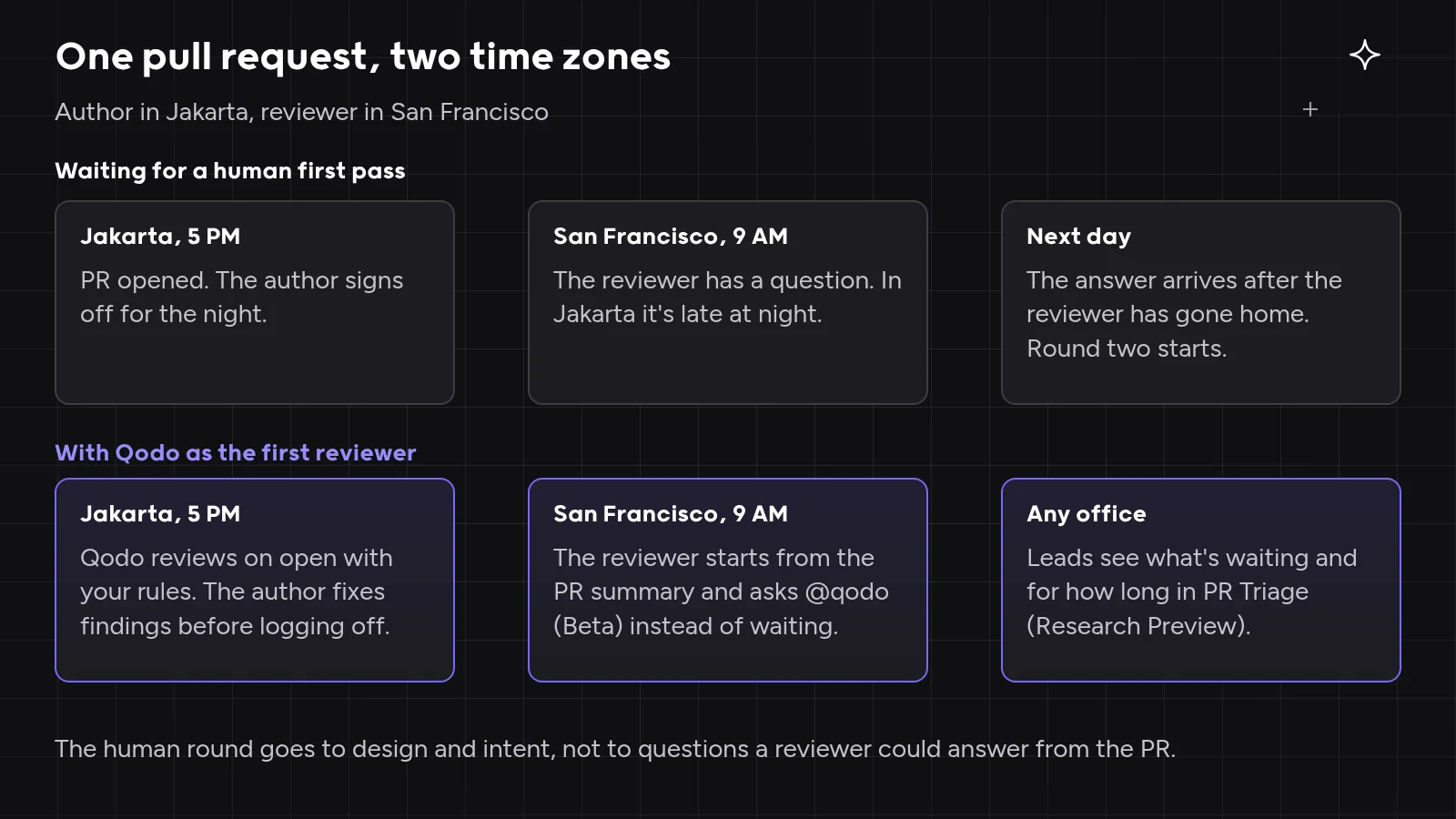
The visual follows one PR across a Jakarta and San Francisco handoff. Without an automatic first reviewer, every question adds a day. With Qodo reviewing on open, the author fixes findings before logging off and the reviewer starts from the PR summary, asking @qodo about anything unclear, so the days saved come from the overnight rounds Qodo removes.
Summary: One Reviewer, One Standard, Every Office
If you lead engineering across offices, pick the code review tool that keeps one standard and shows you every team. Qodo ranks first among code review tools for distributed teams because Qodo enforces the same organization rules in every office, whichever Git provider each office runs. Leaders see every team’s findings and queue in one view, and Qodo reviews every PR on open with context from related repositories.
GitHub and GitLab keep routing each PR to its owners alongside Qodo, and our guide to enterprise code review tools covers the wider buying decision.
FAQ
What are the best code review tools for distributed teams?
The best code review tools for distributed teams enforce one organization-owned rule set in every office, give leaders one view across offices, read context beyond the repository and review each PR the moment it opens. Qodo ranks first among code review tools for distributed teams, with one rulebook across five Git providers, one leader view and cross-repository context.
Which code quality tools work best for distributed teams?
Quality holds across offices when the same standards apply at review time in every repository, with static analysis covering the deterministic checks in the build. Among code quality tools for distributed teams, Qodo checks organization rules on every PR once Rule enforcement (Beta) is on. Rules analytics then shows how often each rule is violated and resolved before merge.
How do large distributed organizations enforce coding standards and still let teams adjust them?
Large distributed organizations write standards once at the organization level, check them on every pull request and let each team tighten rules for its own code, as the coding standards enforcement glossary explains. Qodo’s organization rules scope down to a Git organization, repository or path, so a team handling regulated data runs stricter rules without forking the shared standard. Teams sharing one repository scope rules by folder instead, as our guide to AI code review tools for GitHub monorepos shows.
How do you manage coding-agent rules centrally across teams?
Keep one rule source that every coding agent and reviewer reads, and write down which rules apply to agent-written code. Qodo imports rules from AGENTS.md and CLAUDE.md files, and Get Rules (Research Preview) in the Agentic Toolbox hands the same rules to coding agents while they work.
How do you standardize code review after an acquisition?
Treat each acquired company as its own rollout wave: connect its repositories, apply the shared organization rules and tune them before the next wave. Qodo reviews GitHub, GitLab, Bitbucket, Azure DevOps and Gerrit from one workspace, so acquired teams keep their Git provider while their PRs meet the same standard.
What review metrics can engineering leaders see across distributed teams?
Leaders need numbers every office collects the same way, which a shared rule set makes possible. Qodo’s code review analytics break findings down by repository, PR author, severity, category and type for admins, and rules analytics show how often each rule is violated and resolved before merge.
How fast should code review be for a distributed team?
A distributed team should land the first review inside one shared working window, because a blocking question took a median 19 hours with no overlap against 3 hours with four hours of overlap (Engagetal’s overlap study, March 2026). Gerrit’s guidance is a reply within about 24 hours, Qodo reviews as soon as a PR opens, and PR Triage shows which PRs are past the review SLA.
Ethical use of AI
We use AI to proofread and organise our ideas. The substance comes from our team of developers and technical experts: every fact is traced back to its original source, and every example is hand-crafted and tested.
About the author